logo
trucking services
Paige Logistics (7)
dot-1

How to Choose the Right Trailer for Your Cargo


Know Your Freight: Weight, height, length, fragility

Understand Route Requirements: Permits, regulations, loading docks

Factor in Handling Needs: Crane, forklift, or roll-on capabilities

Common Mistakes to Avoid

  • Choosing a flatbed when height clearance is an issue
  • Using a dry van for sensitive electronics in extreme temperatures
  • Not checking state permits for oversized loads

Cost Considerations

  • Dry Van: Budget-friendly, widely available
  • Reefer: 10-20% higher than dry van due to refrigeration
  • Flatbed/Step Deck: Varies based on load complexity
  • RGN/Double Drop: Premium pricing for heavy-duty handling

Flatbed Trailers

Best For: Machinery, building materials, oversized cargo

These trailers offer flexibility for loading from any angle and are ideal for non-standard sized cargo.

Specs:

  • Length: 48-53 feet
  • Load Capacity: 48,000 lbs

Bonus: Great for loads that require cranes or forklifts.

The most common types of specialized trucking trailers and flatbed trailers include:

  • Removable Gooseneck Trailers (RGN)
  • Stretch Double Drop Trailers
  • Step Deck Trailers
  • Conestoga Trailers
  • Sidekit Trailers
  • Lowboy Trailers

It is important to take note of the high bed trailer specification, flatbed trailer sizes, the flatbed weight limit, or total weight of the freight, as well as the dimensions of a particular type for proper and accurate flatbed & specialized trucking rates.

When discussing flatbed semi trailer deck height, from the ground, each flatbed truck and its freight is different from the other types, so the information that you will be seeing here should be used and treated as your general guideline of trailer weight and flatbed capacity.

Typically, most of the platform trailers mentioned here are capable of handling freight that may even exceed the dimensions and weights for a required permit in a particular province, and even premium charges that need to be obtained prior to your specific type of shipment.

IMPORTANT NOTE:

It is important to note when understanding trailer sizes that trailers for hauling vary in size, dimension, and weight capacity of which is based on the corresponding trucking specifications, or axle configuration of a particular semi-tractor and trailer used.

For each trailer type, height, and dimensions, the corresponding weight and dimension capacity are also listed, and the figures are listed approximately.

Thus, the numbers or figures that you will see on the list can be used as an estimated guideline for freight and load planning and understanding semi-truck trailer height.

More importantly, these figures should not be used as your basis for making loading calculations that require accuracy and precision.

Legal Axle Weights in BC

The maximum legal axle weight allowed on a highway:

  • Single Axle 9 100 kg, any one axle of a Tridem or Tandem Axle Group 9 100 kg.

The difference axle weight between adjacent axles 1 000 kg maximum; the gross weight on the steering axle of an all-wheel-drive three-axle truck is 7,500 kg maximum.

The gross weight of any two adjacent axles in a Tridem Axle Group is 17,000 kg maximum (except in the case of a tridem pole trailer), the sum of the axle loads on the drive axles and jeep axle in a tandem drive truck tractor in combination with a single axle jeep and lowbed semi-trailer is 24,000 kg.

The maximum licensed gross vehicle weight of a vehicle or combination of vehicles must not exceed 63,500 kg.

A person may, without a permit, operate the semi-trailer of a 2-vehicle combination with a spread tandem axle, if the inter-axle spacing between the 2 non-steering axles exceeds 185 cm but does not exceed 307 cm, provided that the sum of the axle weight for both axles does not exceed 9,100 kg or a utility trailer type.

A person must not, without an overload permit, drive or operate on a highway when:

  1. a vehicle or combination of vehicles having a gross weight on the drive axle that is less than 20% of the gross vehicle weight, or
  2. a combination of vehicles with a gross vehicle weight in excess of 38,000 kg unless the towing vehicle has a tandem or tridem drive axle.

How much weight can a flatbed carry?

Axle GroupMaximum
Single9,100 kg
Tandem9,100 kg
Tridem17,000 kg
Gross Vehicle Weight38,000 kg

Flatbeds are extremely popular and are widely used because they exude a great sense of versatility. Generally, when determining a trailer for a semi truck, with all the types, a flatbed is used to load the product on its tip, sides, and rear. With these capabilities, flatbeds have truly become the primary and leading assets of the trucking industry.

This kind of trailer has the capability to carry a maximum legal freight dimension and flat deck trailer weight, which are as follows:

  • Flatbed Trailers Maximum freight weight of 48,000 lbs
  • Tri-axle Trailers Maximum Freight Weight of 65,000 lbs

Adding a number of axles can increase the limit. To determine the 48′ flatbed trailer weight capacity, keep in mind that the maximum cargo a carrier can unload from each axle is 20,000 lbs.

Flatbed Trailers Maximum freight dimensions:

  • Maximum Flatbed Trailer Length- 48 ft – 53 ft trailer height 
  • Maximum Flatbed Trailer Width- 8.5 ft
  • Maximum Legal Freight Height- 8.5 f

Dry Van Trailer

Dry Van trailers are generally enclosed and are commonly used to carry and protect the freights from the harmful elements of the weather or the roads. Freights can be loaded on the rear and are commonly loaded using a loading dock. It is similar to a curtain van and it can be loaded from its side too.

How much does a dry van trailer weigh?
Legal weight and dimensions are:

  • Dry Van Maximum freight weight is 42,000 lbs to 45,000 lbs.
  • Dry Van Tri-Axle Freight weight is 63,000 lbs

Dry Van Maximum freight dimensions:
Maximum Dry Vans Length- 48 ft – 53 ft

  • Maximum Dry Vans Width- 8.2 ft
  • Maximum Dry Vans Height- 8 ft

Best For: Non-perishable goods, electronics, clothing

Dry van trailers are the most commonly used in freight shipping. Enclosed and weather-resistant, they offer general protection for standard cargo.

Specs:

  • Length: 53 feet (standard)
  • Load Capacity: 45,000 lbs

Use Case Example: A retail company ships electronics across the country and needs protection from rain and theft. A dry van is the no-brainer.

Refrigerated Trailers and Reefers

Need to keep your cargo cool? Refrigerated trailers, or reefers, are your best bet. These are the climate-controlled condos of the road, perfect for transporting perishable goods such as food, flowers, and pharmaceuticals.

Paige Logistics has the refrigerated trailer you need, regardless of the size of your load or the type of cargo you need shipped. Dedicated Transport Services for FCL, LCL, LTL FTL Freight Shipping.

Legal weight and dimensions are:

  • Refrigerated Trailers Max freight weight is 42,000 to 45,000 lbs
  • Tri-Axle Trailers Max freight weight is 63,000 lbs

Refrigerated Trailers Maximum freight dimension:

  • Maximum Refrigerated Trailers Length- 48 ft – 53 ft
  • Maximum Refrigerated Trailers Width- 8.2 ft
  • Maximum Refrigerated Trailers Height- 8 ft

Best For: Perishables, pharmaceuticals

Reefer trailers maintain a controlled temperature environment. They’re essential for cold chain logistics.

Specs:

  • Temp Range: -20°F to 70°F
  • Load Capacity: ~43,000 lbs

Pro Tip: Make sure your carrier is certified for cold chain compliance to avoid spoiled loads.

Lowboy Trailer

A Lowboy Trailer is a non-powered trailer that is commonly used to haul freight. They have a low deck height, making them suitable for transporting heavy-duty construction equipment that exceeds the height limitations of other trailers. They can carry loads up to 80,000 pounds with the proper permits.

These kinds of trailers are generally designed to carry and transport taller goods and items. This means that the items to be carried to a Lowboy Trailer are taller than the legal height of items that are commonly carried by a tractor-trailer flat bed.

Our expert advisers will indicate if you need permits for your particular load or type of freight. Basically, a lowboy that has two axles can haul around 40,000 pounds. The maximum weight and dimensions are as follows:

  • Lowboys Maximum weight is 40,000 pounds for a 2-axle Lowboy Trailer; an additional weight of up to 95,000 pounds, depending on the number of axles used (weight of the trailer and weight of the load added together).

Lowboys Maximum Dimensions:

  • Maximum Lowboy Well Length- 24 ft – 29.6 ft
  • Maximum Lowboy Well Height- 18 in – 24 in
  • Maximum Legal Width- 8.5 ft
  • Maximum Legal Freight Height- 11.5 ft – 12 ft
  • Maximum Legal Overall Load Height- 14 ft

Step Deck Trailer – Drop Deck Trailer

Similar to flatbed trailers, step deck trailers feature a lower deck that allows for the transportation of taller loads that exceed the height limits of standard flatbeds. These trailers are perfect for carrying large machinery and building materials. When height is a concern, step-deck (or single-drop) and drop-deck (or double-drop) trailers come into play. These trailers are designed to transport tall items that wouldn’t fit under standard overpasses when loaded onto a flatbed. The ‘step’ or ‘drop’ in their design lowers the trailer’s bed, providing the extra clearance needed for tall cargo.

Extendable Double Drop Trailers

Stretch single-drop deck trailers, also known as double-drop trailers, have a low deck that accommodates taller loads while keeping the center of gravity low. This makes them suitable for transporting heavy and oversized equipment.

Best For: Taller freight that exceeds height limits on flatbeds

Specs:

  • Upper Deck: 11 feet
  • Lower Deck: 37-41 feet
  • Max Height: 10 ft tall freight

Example: Shipping construction equipment like bulldozers.

Best For: Extra tall or oddly shaped freight

Specs:

  • Well Length: 25-29 feet
  • Max Height: Up to 11.6 ft

Perfect for moving industrial tanks, generators, or large sculptures.

Single-Drop Deck Trailers

Stretch single-drop deck trailers, also known as double-drop trailers, have a low deck that accommodates taller loads while keeping the center of gravity low. This makes them suitable for transporting heavy and oversized equipment. When your cargo is too long for a standard flatbed, an extendable flatbed trailer is the solution.

These trailers can stretch to accommodate longer loads, such as oversized equipment and construction materials. Stepdeck Trailers are otherwise known as drop deck types and they are in fact a version of the flatbed trailer design that mainly consists of a bottom and top deck.

These trailers are specifically designed to carry and haul freights that cannot be carried or transported on a standard type of flatbed, which is usually due to height restrictions. A good example is heavy haul and machinery transport 

The maximum legal dimensions and weight for a Stepdeck trailer – Stepdeck Trailers are as follows:

    • Stepdecks Maximum freight weight is 48,000 lbs
    • Tri-Axle Maximum freight is 65,000 lbs

Stepdecks Maximum freight dimensions:

  • Maximum Stepdeck Trailer Length- 48 ft – 53 ft
  • Maximum Stepdeck Trailer Width- 8.5 ft
  • Maximum Legal Freight Height- 10 ft

Extendable Flatbed Stretch Trailers

These are extendable flatbeds and are otherwise known as flatbed stretch types. They are mainly used for carrying loads or freight that are excessively long and cannot be carried by a standard type of trailer.  It is also a type of trailer that provides maximum support, avoiding the possibility of overhanging freight.

The maximum legal dimensions and weight for a Flatbed Stretch Trailer are as follows:

48-foot tractor-trailer dimensions are included with extendable flatbeds with a maximum freight weight of 43,000 lbs

Tri-axle trailer weight limit in Canada

  • The maximum weight for a tridem axle on a municipal road is 17,000 kg, and the maximum GVW is 53,500 kg.
  • The tri-axle trailer’s maximum freight weight is 65,000 lbs

Extendable Flatbeds Maximum freight dimensions:

  • Maximum Extendable Flatbed Trailer Length- 48 ft – 80 ft
  • Maximum Extendable Flatbed Trailer Width- 8.5 ft
  • Maximum Extendable Flatbed Legal Freight Height- 8.5 ft

Best For: Extra-long freight like steel beams or pipes

Specs:

  • Extendable to 80+ feet

Heads Up: Some states require special permits for extra-long loads.

Stretch Single Drop Deck Trailer

Stretch Single Dropdeck Trailers are specifically designed to carry and haul freights that are very long for a standard or traditional step deck due to length restrictions. It also provides support thus, preventing overhang.

Legal weight and dimensions are as follows:

  • Stretch Single Drops Max freight weight is 45,000 lbs.

Stretch Single Drops Maximum freight dimensions:

  • Max Stretch Single Drop Trailer Length- Main Deck 35 ft – 63 ft
  • Max Stretch Single Drop Trailer Width- 8.5 ft
  • Max Stretch Single Drop Legal Freight Height- 10 ft

Stretch Double Drop Deck Trailer

A Stretch Double Drop Trailer is generally used for carrying oversized shipments. Its lower deck allows you to load products that can be as tall as 10 feet. It also comes with a so-called “well” a longer piece at the trailer’s back deck and middle portion.

The well usually measures from 25 feet to 29 feet. Legal weight and double drop trailer dimensions are as follows:

  • Stretch Double Drops Max freight weight is 58,000 pounds.

Stretch Double Drops Maximum freight dimensions:

  • Max Stretch Double Drop Trailer Length- Main Deck 29 ft – 65 ft
  • Max Stretch Double Drop Trailer Width- 8.5 ft
  • Max Stretch Double Drop Legal Freight Height- 11.6 ft

Extendable Double Drop Trailers

The Extendable Double Drop Trailer is commonly used to carry and haul freight that come with excessive length and can never be carried by a standard double drop trailer. Depending on the weight, this trailer can either have 2 or 3 axles.

Legal weight and dimensions are:

  • Extendable Double Drops Max freight weight is 44,000 lbs
  • Tri-Axle Double Drops Max weight is 58,000 lbs

Extendable Double Drops Maximum freight dimensions:

  • Max Extendable Double Drop Trailer Length- 29 ft – 50 ft
  • Max Extendable Double Drop Trailer Width- 8.5 ft
  • Max Extendable Double Drop Legal Freight Height- 11.6 ft

RGN or Removable Gooseneck Trailers

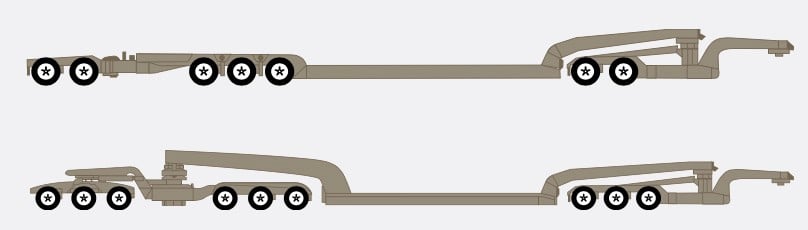
Removable Gooseneck RGN Trailer is excellent for carrying tall and long freight by heavy haul trucking companies. The trailers feature a detachable front end, allowing the trailer to drop to the ground and create a ramp. This design makes it easy to load and unload heavy machinery that can drive directly onto the trailer. Depending on the load, RGNs can use multiple axles for added support.

It comes with a detachable front, allowing the trailer to be dropped on the ground in order to create a ramp. Gooseneck trailers are extendable and capable of hauling and carrying freight weighing up to 150,000 pounds. It can go from 3 axles up to 20 plus axles for heavier shipments. RGN Trailers’ removable goosenecks are more specialized, so they render a more expensive usage.

Legal weight and dimensions of a Removable Gooseneck Trailer RGN are as follows:

  • RGN’s Minimum freight weight, dependent on axle configuration, is 44,000 to 150,000 lbs.

9 Axle Trailer

Equipment Dimensions:

  • Combined length: 103′
  • Lower deck length: 25′
  • Trailer width: 8’6″
  • Deck height: 18″ to 24″
  • Empty weight: 65 000 Lbs

Commodity Dimensions

  • Length: 25′
  • Width: 8’6
  • Height: 11’8″ to 12′
  • Weight: 105 000 lbs maximum 

Removable Gooseneck – RGN Maximum freight dimensions:

  • Maximum Removable Gooseneck – RGN Well Length- Main Deck 29 ft
  • Maximum Removable Gooseneck – RGN Well Width- 8.5 ft
  • Maximum Removable Gooseneck – RGN Legal Freight Height- 11.6 ft 

Stretch RGN

The Stretch Removable Gooseneck Trailer is designed to carry and haul freight that are too long to be carried by a standard type of RGN. Depending on the weight of the freight, axles may range from 3 axles or higher.

Stretch RGN trailers combine the features of RGNs with an extendable deck, making them ideal for transporting long and heavy loads that standard RGNs cannot accommodate. They are commonly used in the construction and heavy equipment industries.

This means that the heavier the load is the more axles are to be used. Legal weight and dimensions are:

Length: The main deck length can extend up to 65 feet. The total trailer length can reach up to 80 feet or more, depending on the number of axles and the specific trailer design.

Width: The maximum legal width is generally 8.5 feet (102 inches).

Height: The height of the load on the main deck (also called the well) typically should not exceed 11.5 feet, but this can vary depending on state regulations and permits.

Weight:

  • Gross Vehicle Weight Rating (GVWR):
    • The maximum allowable weight can vary significantly depending on the number of axles used. With the right configuration, Stretch RGNs can legally haul up to 160,000 pounds or more.
    • Typically, a Stretch RGN trailer with three axles can haul around 42,000 to 50,000 pounds.
    • Additional axles increase the weight capacity, with some configurations allowing for up to 20 axles.

State-Specific Regulations:

  • Permits: Oversized loads often require special permits, which vary by state. These permits specify the allowable dimensions and weights for the load being transported.
  • Axle Weight Limits: Axle weight limits can differ by state, but typically, they are around 20,000 pounds per axle for standard loads. Special configurations and permits can increase this limit.

Special Considerations:

  • Route Planning: Transporting oversized loads requires careful route planning to avoid low bridges, weight-restricted roads, and other obstacles.
  • Escort Vehicles: Depending on the size of the load and state regulations, escort vehicles may be required to ensure safe transport.

Stretch RGN trailers are essential for hauling oversized and overweight loads that standard trailers cannot accommodate. Their ability to extend in length and support heavy weights with multiple axle configurations makes them indispensable in industries like construction and heavy equipment transport. However, transporting such loads requires adherence to legal weight and dimension limits, often necessitating special permits and careful planning.

Stretch RGN or Removable Goosenecks Maximum freight weight is 45,000 pounds to 150,000 pounds or more.

Stretch RGN Maximum freight dimensions:

  • Max Stretch RGN Length in Well- Main Deck 29 ft to 65 ft
  • Max Stretch RGN Trailer Width- 8.5 ft
  • Max Stretch RGN Legal Freight Height- 11.6 ft

Best For: Heavy equipment that rolls or drives onto the trailer

Specs:

  • Load Capacity: Up to 150,000 lbs
  • Ideal for: Excavators, large tractors

Insider Tip: RGNs save you time during loading and unloading.

Conestoga Trailer

Conestoga trailers come with a rolling tarp system that is used to cover and uncover the trailer and gives protection to the freight. When shipping with a Conestoga trailer, they can come as regular flats or step decks.

  • Conestoga Trailers’ Max freight weight is 42,000 lbs to 65,000 lbs.
  • Various configurations, such as step decks and tri-axles

Conestoga Trailers Maximum freight dimensions:

  • Maximum Dry Vans Length- 48 ft – 53 ft
  • Maximum Dry Vans Width- 8.2 ft
  • Maximum Dry Vans Height- 8 ft

Best For: Freight that needs flatbed flexibility with van protection

These trailers have a retractable tarp system that provides side, top, and rear loading access while protecting cargo from the elements.

Use Case: Valuable machine tools requiring weather protection during transit.

Side Kit Trailers

The Sidekit trailer is equipped with a panel made from either plywood or fiberglass and commonly used for carrying goods that can never be packaged or crated.

Sidekit Trailers’ Max freight weight is 42,000 lbs to 58,000 lbs.

Sidekit Trailers Maximum freight dimensions:

  • Maximum Sidekit Trailers Length- 48 ft – 53 ft
  • Maximum Sidekit Trailers Width- 8.2 ft
  • Maximum Sidekit Trailers Height- 8.6 ft

Super B Trailers

The Super B trailer is equipped with 2 Trailers. 32′ Lead and a 28′ Pup. 

Super B trucks are fantastic for shipping lumber and heavy volume commodities. With 5-6 axles, they can carry up to 95,000 lbs.

  • Super B Trailers Max freight weight is 95,000 lbs
  • Super B Trailers Maximum freight dimensions:
  • Maximum Super B Trailer’s Length- 32 ft
  • Maximum Super B Trailer’s Pup – 28 ft
  • Maximum Super B Trailer’s Height- 8.6 ft

Power Only Trailer

The power only trailer is a special type that is generally used in towing various types of trailers, and it usually comes with a fifth wheel hitch, pintle hitch, and ball and hitch.

Only four axles are allowed when the freight is Maximum Power Only freight weight and dimensions depend on the type of trailer that is being towed / hauled (provincial requirements should be strictly followed).

Intermodal Trailers

Best For: Long-haul shipping via rail and truck

These trailers are designed to seamlessly switch between train and truck, reducing handling and emissions.

Ideal Use: Coastal or international imports being trucked inland.

Specialized Trailer

Beyond the more common types, there’s a world of specialized trailers designed for specific tasks:

Conestoga Trailers: Offers the flexibility of a flatbed with the protection of a dry van, thanks to a rolling tarp system.

Lowboy Trailers: Sit very low to the ground, making them ideal for hauling heavy equipment like bulldozers and industrial machinery.

Auto Haulers: Designed to transport vehicles safely and efficiently, whether you’re moving a classic car or a fleet of vehicles.

Specialized trailers are specifically made for certain types of freight and are commonly used with perimeter, double gooseneck, and dolly trailers. Specialized Trucking Trailers’ max freight weight is 200,000 pounds or more. Maximum Specialized Trucking Trailers dimensions (depends on the regulations imposed by the province)

Enclosed Trailers

An enclosed trailer is like a mobile fortress. It fully contains and protects your valuables—whether it’s furniture, gym equipment, or a dirt bike—from weather, theft, and road debris.

Ideal For:

  • Small to medium-sized equipment
  • Long-distance hauling
  • Securing valuable or weather-sensitive cargo

Key Features:

  • Complete containment and protection
  • Multiple size options
  • Customizable add-ons
  • Rear ramp access
  • LED lighting (optional)
  • V-nose design for better aerodynamics

Pros:

  • High level of safety and security
  • Heavy-duty door options
  • Rear ramp makes loading/unloading easier
  • Color customization available
  • Streamlined design for better fuel efficiency

Cons:

  • Limited space for oversized cargo
  • Higher cost due to enhanced security features
  • Restricted visibility while towing

Enclosed Trailer Price Range:

  • Small (6×12): $3,000 – $5,000
  • Medium (7×16): $6,000 – $8,000
  • Large (8×32): $8,500 and up

Utility Trailers

Utility trailers are open, flatbed trailers designed for hauling a wide variety of items—from furniture to landscaping tools. They are a popular choice for general-purpose use.

Types of Utility Trailers:

  • Angle Utility Trailers: Best for lighter loads (up to 2,000 lbs); affordable and simple
  • Tube Utility Trailers: Stronger frame for heavier loads; more expensive

Key Features:

  • Open design for flexible cargo shapes
  • Wood or metal flooring options
  • Multiple gate sizes
  • Spare tire mount available

Pros:

  • Affordable (especially angle trailers)
  • Improved fuel efficiency due to lighter weight
  • Great for irregularly shaped cargo
  • Compatible with some car models

Cons:

  • No built-in security—cargo is exposed
  • Weather vulnerability (e.g., rain or snow)
  • Lower durability than enclosed trailers

Utility Trailer Price Range:

  • Small Angle Trailer: $1,400 – $1,900
  • Medium Angle Trailer: $1,900 – $2,500
  • Small Tube Trailer: $2,500 – $3,100
  • Medium-Large Tube Trailer: $3,100 – $4,100

53-Foot Semi Trailers

53-foot trailer height typically refers to the vertical dimension of a 53-foot-long semi-trailer, which is a standard size used in freight transportation.

The height of a 53-foot trailer can vary depending on the design and purpose, but the most common overall height is 13 feet 6 inches (4.11 meters)

Key Details:

  • Overall Height: 13 feet 6 inches (4.11 meters) – this is the maximum height allowed on most highways in North America.
  • Interior Height: Generally ranges from 100 to 110 inches (8.3 to 9.1 feet or 2.54 to 2.79 meters), depending on the type of trailer (dry van, reefer, or specialized equipment).
  • Ground Clearance: Varies based on suspension type but usually around 40 inches (1 meter).

Variations:

  • Standard Dry Van or Reefer Trailer: Most common at 13’6” in height.
  • Lowboy Trailers: Shorter overall height, used for hauling tall equipment.
  • Specialized Trailers: May have adjustable or lower profiles for specific cargo needs.

The height of a 53-foot trailer and 53′ truck trailer dimensions is an important factor in logistics, especially for clearance under bridges, tunnels, and warehouse dock compatibility.

Choosing the Right Option for Your Freight Logistics

When it comes to freight logistics, choosing the right truckload trailer isn’t just a minor detail—it’s a deal-breaker. Whether you’re shipping heavy equipment, fresh produce, or oversized materials, the type of trailer you select can significantly affect shipping cost, transit time, and cargo safety.

This guide will help you understand the most common truck trailer types, when to use them, what freight they suit best, and how to ensure smooth delivery from origin to destination.

Navigating the world of tractor trailer types can be complex—especially for international shipments. If you’re shipping from China to Canada and continuing from Canada to the USA, selecting the correct trailer, equipment, and service type is crucial. Knowing the right truck trailer length, load capacity, and special handling needs can make or break your supply chain.

If you’re dealing with over dimensional freight, machinery transport, or construction logistics, not every trailer is suitable. Choosing between flatbeds, step decks, lowboys, or dry van trailers depends on your cargo’s size, weight, and loading method.

Understanding the different types of flatbed trucks and equipment options helps you avoid delays, reduce risk, and keep your freight moving efficiently.

Depending on your trucking services and shipping logistics needs, trailer dimensions and capacity vary widely. It’s essential to start with the exact size and weight of your cargo—including length, width, height, and weight—to find the right fit.

Whether you need a reefer truck for temperature-sensitive freight, a dry van for standard palletized goods, or a flatbed for oversized equipment, matching your load to the right trailer type is key to successful logistics planning.

After determining the semi-truck dimensions—including tractor-trailer length, truck height, and weight limits—you must also plan for how your cargo will be loaded. Consider if your freight requires crane loading, side loading, or dock height compatibility.

For open-deck trailers like flatbeds, you’ll also need to think about flatbed tarping systems to protect your cargo from weather and road debris.

Selecting the proper trailer can be overwhelming, especially when dealing with international freight, cross-border shipping, or heavy haul transportation. Whether you need help identifying the best logistics services or understanding the differences between trailer types with pictures and specs, our team is here to guide you.

Frequently Asked Questions

“Turning the skid” is a loading technique that maximizes space utilization and allows for a higher number of skids to be loaded into a truck. To “turn the skid,” use a forklift to move the pallet from the right side of the trailer to the left side of the trailer.

Place the skid next to it lengthwise (parallel to the skid stringers) on the right, leaving it no deeper than 42 inches from the back of the vehicle. In the following row, place the skids from left to right, with the first skid oriented lengthwise and the second skid oriented widthwise. Thus, the area is utilized more efficiently. To employ this method, the skids must be manufactured as “4-way skids” or “4-way pallets” so that forklift transport is possible from all directions.

The standard 40″ x 48″ dimensions of a hardwood pallet permit loading of two pallets side by side in the majority of trailers. Some international containers and refrigerated trailers may be too broad for ordinary skids, necessitating specialized skids. Turning skids also provides greater protection against shifting during shipping than straight loading when shipping from Canada to California.

The flatbed weight limit top out at 48,000 pounds (24 tons). When selecting the right trailer is about understanding your cargo’s specific needs and how different trailers can meet those needs. Whether you’re a seasoned logistics professional or a small business owner venturing into the world of cargo transportation for the first time, the key is to arm yourself with knowledge. By understanding the strengths and limitations of each trailer type, you can make choices that save you time, money, and headaches down the road.

Remember, the best decision is an informed one. So, take the time to consider your cargo’s unique requirements, and let that guide your trailer selection process. With the right knowledge and a clear understanding of your needs, you’ll find the perfect trailer to keep your goods moving safely and efficiently on the open road. When hitting the road, safety and resilience are non-negotiables. Whether you’re aiding a friend’s relocation or transporting materials for your business, having the right tools is paramount.w

Without a specific permit, the combined weight of the tractor and trailer cannot exceed 80,000 pounds. Typically, a loaded trailer might weigh up to 45,000 pounds, leaving 35,000 pounds for the weight of the tractor. Long-haul stretch tractor-trailers have been recorded to weigh in excess of 35,000 pounds; consequently, the trailers they can tow must weigh significantly less, say 40,000 pounds (or 43,500 lbs. maximum.) According to DOT requirements, weights must be distributed uniformly over all axels of a trailer, so that no axel is “overweight.” Weights must be accurately determined, and FTL cargoes with gross weight considerations must be reserved in advance.i

The answer depends on the items being shipped. We know that the maximum weight that can be loaded into a dry van (53-foot trailer weight limit) is between 43,000 and 45,000 pounds, and that the maximum weight that can be loaded into a Reefer is 43,500 pounds.r

On LTL trailers, such as 28′ puppies, the inside height can range from 107″ to 110″, while the door height remains constant at 104″. Particularly with all moving services, It is prudent to be cautious of the height at which boxes are stacked on skids.

If the product being transported is lighter, the skid height can be increased. The pallet size you choose should be sufficient not just for the interior height of the vehicle, but also for the door clearance. This is due to the fact that the forklift must elevate the skid at least an inch off the ground and into the truck.m

Some 53 ft trailer’s have interior heights that range from 110″ to 114″ and dip in a few places. 105″ is the height of the door on these trailers.

If the freight forwarder, shipper and/or receiver are cooperative, floor loading or hand packing a truck can result in higher cost savings. Obviously, only lightweight cargo may be transported in this manner. Still, there is a trade-off to consider: while packing more saves money, loading and unloading the freight by hand may take longer.

Trailer Sizes

Trailer TypeLengthWidthHeightMax Weight
Dry Van48 – 53 ft8.5 ft9.2 ft45,000 lbs
Refrigerated48 – 53 ft8.5 ft~8.5 ft42,000 – 45,000 lbs
Flatbed48 – 53 ft8.2 – 8.5 ft~8 ft48,000 lbs
Step Deck48 – 53 ft8.5 ft~10 ft48,000 lbs
Double-Drop~29 ft8.5 ftUp to ~11.5 ftUp to ~45,000 lbs
Lowboy~24 – ~29.6 ft8.5 ftUp to ~11.5 ft~40,000 lbs

10 feet or 120″

The weight falls between 42,000 and 45,000 pounds.

8.5 feet or 102″ wide

While the standard height for flatbed trailers is 8.5 feet, specific designs and configurations can lead to slight variations. a standard flatbed trailer typically measures 8.5 feet (102 inches) from the ground to the top of the trailer itself. However, other variations exist, with certain models being around 5 feet high. It’s important to note that the maximum height of freight loaded onto these trailers is generally limited to 8 feet 4 inches.